Let Me Come With You To Narnia

After we finished reading C. S. Lewis’ THE LION, THE WITCH, AND THE WARDROBE last year, I made Henry promise that if he ever found an entrance into Narnia, then he would most certainly have to let me know. I didn’t want to get left behind, you see.

We checked various closets, cabinets, and doorways over the following months, but we have yet to stumble upon a proper gateway to Narnia. I can see the disappointment on Henry’s face after the dozenth or so time wrenching open the narrow closet door that guards our board games and vacuum cleaner. “But,” I remind him, “if you stop looking for magic, you’re guaranteed to never find it.” He nods, then returns to checking beneath the sinks, just in case.

His disappointment reminds me of my own. I’ve always loved stories where the otherwise normal main character gets thrown into a new world through some magical portal. Narnia is perhaps my favorite, with the Oz series by L. Frank Baum a close second. All I needed as a child, I knew, was to wait for the right tornado to come along, or to wait for that portal to appear behind the next closed door or—dare I hope?—through that ancient wardrobe? But, for whatever reason, I was never chosen. The door never revealed itself to me.

****

Henry and I just finished listening to PRINCE CASPIAN on audiobook, which we’ve been working our way through during our morning commute to school over the past few weeks. It’s not my favorite of the series (VOYAGE OF THE DAWN TREADER ranks first for me), but CASPIAN has several scenes that rank among my most cherished in the Narnia series. I wondered how Henry would enjoy it, especially given the more complicated narrative, which includes a pretty hefty flashback that takes up a big chunk of the book. But he stayed fairly attentive, both quiet and focused as Lynn Redgrave’s excellent narration flowed from the speakers and filled the car each morning.

In one of my favorite moments, Lucy tries desperately to convince her siblings that she’s seen Aslan and that He wants them to follow Him down a path that seems more difficult than the one they’d prefer to travel. The elder siblings and Trumpkin the cynical dwarf are unable to see Aslan, and thus remain resistant to Lucy’s pleas.

Even Lucy, the epitome of childlike faith in Lewis’s fantasy world, had at first struggled to connect the feeling in her heart to the reality of Aslan’s presence. But once she saw Aslan, his leonine shadow finally becoming solid before her eyes, she wanted desperately to convince her siblings of what she knew to be true. But Peter, Susan, and (to a lesser degree) Edmund struggled to trust her, to trust in a magical thing that they could not immediately touch, even though they stood in the very midst of a magical land that they had known so well once upon a time.

Around this time in the story, Henry spoke from his booster seat behind me. “Dad,” he said, “I think I know why Lucy can see Aslan.”

I peeked back at him through the rear view mirror and could see a look of concentration on his face. “Why’s that, buddy?”

“I think Lucy can see Aslan because she still BELIEVES in magic,” he replied slowly.

He’s right, of course. The others, especially Peter and Susan, would deny that they no longer believe in magic, but it’s true that Lucy maintains a more controlled grip on her faith than her siblings do. She still believes in magic—deep magic—and that’s why she is allowed to see Aslan first.

****

I hope Henry never stops believing in magic altogether. It’s a fleeting feeling, that assurance of the magical, at least in terms of the rest of our life. For a few years we can be carried along with the wild possibilities of magic in our hearts, and no one even judges us. But we all lose society’s permission before long, and so our world gets a little dimmer.

I think Henry’s on to me by now though, in our search for a portal to Narnia. He plays along for a little while, but eventually he gives me this calculating glance, mouth curled up in a wary grin, and asks, “Are you being serious, Dad? Is this for real?”

He wavers already. I can see it. He’s experienced so much darkness in his almost six years that I can sometimes see how it puts pressure on the natural whimsy of his spirit. But so much of childhood, the best parts really, are caught up in the whimsical, the fantastic, and the magical. I hope he always keeps some part of that with him as he grows up, hidden carefully away from the demands and disapproval of adulthood.

Because it is people like him, the ones who maintain a fragile faith in the deep magic, the ones who keep checking wardrobes and closets and spare rooms—they’re the ones who will be able to see Aslan when all others cannot. Because if he holds fast, if he maintains his faith, if he refuses to let the world strip him of child-like whimsy, if he does all that, then he’ll never ever grow too old to return to Narnia, again and again and again.

And maybe, just maybe, he’ll bring me along with him.

Danger’s Not So Scary When Your Daddy Makes You Brave

A certain part of my heart longs for these moments to never change. I look back on pictures like this one, where my oldest son tastes the salty breeze on his lips for the first time, feeling the sand underneath his toes and laughing out loud at this wholly new experience. I look back and want to freeze it, but in something more than a single picture, more solid than a flimsy memory, more lifelike in substance than what a camera can fashion.

Because that little person who could not stand without my strength to guide him no longer needs my arms to stand. He’s got it.

He no longer needs my hands to grab on to as he walks towards the ocean water. He’s got it.

He no longer needs me to lift him up to dodge the crashing waves. He’s got it.

He’s been back to the beach many times since this initial adventure down in Pensacola five years ago. He’s swallowed more sea water than I’d ever thought was medically possible. He’s gotten sunburned, wind blown, knocked over, and covered in sand. He’s built sandcastles and torn them down. Dug holes and filled them in. Fought a jellyfish without success. Buried friends and family alike in shallow graves upon the shore. Chased a kite, dodged a bird, and very nearly ate a live crab when his parents looked away for a single second. A whole lifetime of experience between then and now.

I never wanted him to change, even as I knew he probably couldn’t help it. I wanted him to stay the age of tiny feet, growly hugs, chubby legs, and soft hands that held so tightly to my own. But, of course, he didn’t. He left all that behind as he ventured onward in life.

So I have a picture of that age. And a memory. Both provide a hint of the real thing, but maybe it’s enough for now. Enough to trigger his squeezes on my fingers that I can almost feel, or his smile so loud that I can almost hear it, or the touch of sand underneath my feet as they scoot forward, inch by inch, shuffling alongside those tiny, miniature toes as we make our way closer and closer to the danger of the ocean waves. He’s not worried.

After all, danger’s not so scary when your daddy makes you brave.

Drinking Hot Coffee is Not for Moms of Young Kids

Each day, my wife makes a concerted and persistent effort to consume some small bit of caffeine. After being up and down all night with a newborn, and after being up and down all day with a two- and five-year-old, she’s well and truly tired, as her energy flags and her emotional well-being turns fragile.

So close!

So she seeks out a balm from the maternal chaos in the form of coffee. In between nursing and comforting and cleaning and holding and loving and soothing, she finally makes herself a quick cup of joe. But that’s not the hard part.

No, any fool can MAKE a cup of coffee. Only a master can actually DRINK it.

The kids can sense, from any point in the house, when exactly Mom seats herself on the couch, gives a slight sigh, and brings the cup to her mouth. At that moment, their ears vigilant for the precise second the cup reaches her lips but before she can consume a drop of the life giving substance, they throw themselves wholeheartedly down the stairs or off a bed, crash their torsos to the ground, and emit a screech of such agony and suffering that even Satan himself takes notes on the dehumanizing effect of this particular howl.

So she places her cup down on the end table or the counter or the window sill, races to confront this latest catastrophe, and is swept away on the winds of life as her patient and faithful coffee cup sits by itself, lonely, forgotten, full, and slowly growing colder and colder.

Maybe Mom makes it back to rescue the remaining dregs through a quick microwave warm up before giving her efforts a second try. But just as often, I will discover the cup (or cups) spread throughout the house when I return from work.

For its in their fullness of life and liquid that I can see a concrete and ever-present example of a mother’s love, kindness, and sacrifice.

Watching Them Walk Away

At the beginning, the world splays out in front of us, wide and open and always at least a little bit terrifying. The fear never really goes away as we age, but our world certainly seems to grow smaller over time.

Adventure awaits!

My boy is nearly three, with yet another demarcation point in his life coming up as his birthday month looms before us. He SEEMS older already. His personality flexes and evolves on a daily basis, as he seeks to sort out his part in this life and as he strives for self-sufficiency and independence in all facets of living. He shoos his parents from the bathroom so he can have “pribacy” while he takes care of business. “I got it,” is his constant refrain. Parental help is anathema to his very philosophy of life. After all, he can dress himself, thank you very much.

To a certain extent, I’m grateful for his ability to start taking care of himself in the smaller things, as it helps reduce the load on me and his momma. But with each new task he commandeers for his own use, our involvement lessens and our influence wanes. And with that loss of input, we come to this point confronting us now, where his personal taste in clothing and the accompanying accoutrements take preeminence over any thoughts that I might have in the appropriateness of his choices.

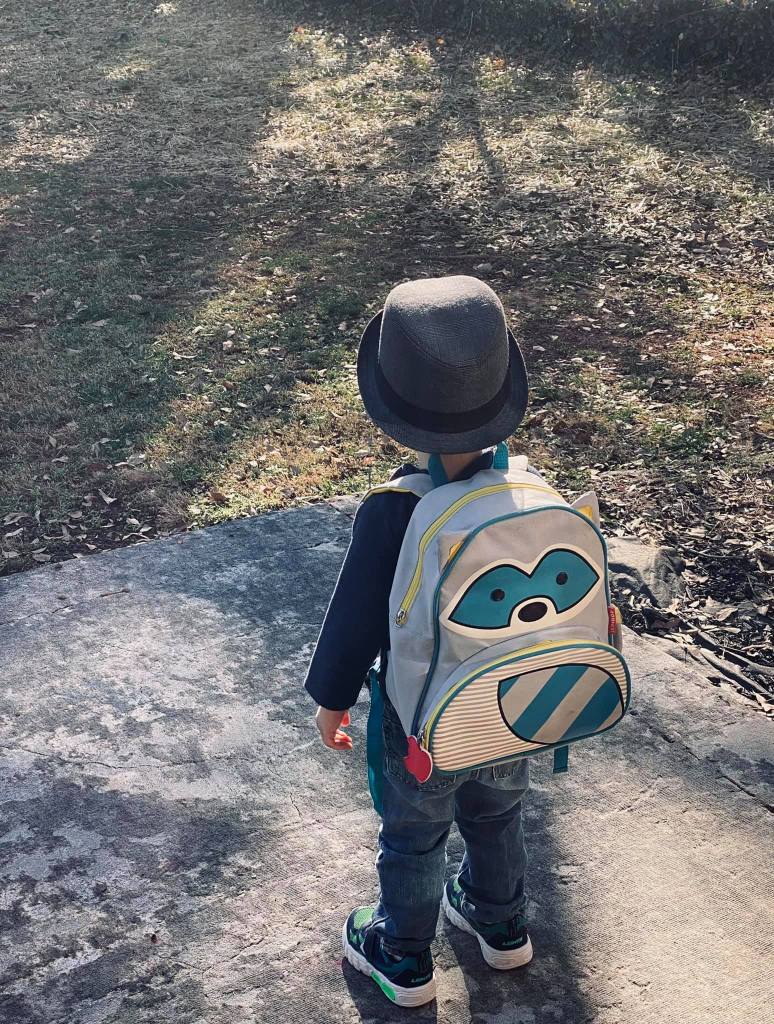
But it works, though. He’s ready for that wide open world before him. His backpack is filled with all the necessities, and his hat—donated by his haberdasher-in-training older cousin—provides the ideal notions of style and practicality, all at once. His shoes, filled with ever-growing toddler feet and a veritable light show shrieking outward from the sides, are sturdy choices when facing the rough paths that he will soon traverse.

And his shoulders are squared, strong, and not yet burdened by the struggles he will inevitably bear—struggles that will only increase in intensity and weight as the years pass and as the innocence of childhood fades away. Even now, he stands tall amidst the temporary death of winter, his small lungs sucking in breath and expelling clouds.

I have a few years left where my opinion may matter to him. A few years left where I can seek to provide guidance and wisdom and perspective. And after that? He’ll be on his own, facing down the unknown.

But even at that point, maybe, maybe, maybe—and this remains just a flickering hope in my soul—maybe on the occasional occasion in the future, he might still reach out his gentle fingers, find my open hand, pull me down close to him, and whisper in my ear that he needs my help.

Sure thing, best bud. Sure thing.

Drifting Father and Father from Shore under the Relentless Son

Even during a beach vacation, I have little interest in plying my strength against the ancient ocean’s mighty blows or fending off the constant accumulation of wind-blown salt deposits upon my eyeglasses. And so I remain quite content to live indoors with my books, or, if my wife gives me that sweet, sweet look and begs most heartily as only the world’s prettiest woman can, perhaps I might even venture out on the shores of the Atlantic itself (for a moment or two, though still with books in hand and a frantic eye towards escape).

And yet…and yet I have a three-year-old son, who thrives in the sand and salt of the mighty ocean, those selfsame substances that surround us and have grown quite fond of taking up residence in all of our most intimate fleshy crevices. Henry does not yet truly understand his father, for he cannot fathom why his dad would choose the warm, dry comfort of a roomy reading chair or the gentle delights of Pat Conroy’s delicious dialogue and his delectable prose, over Henry’s preferred pastime of striding confidently into the attacking waves and inadvertently inhaling the dirty detritus of the world’s greatest shared toilet. And Henry’s lack of emotional understanding comes equipped with a firm confidence that Daddy’s way cannot possibly be correct.

Therefore, when he can longer stand to see me happy, he grabs my hand and pulls me out of the house and towards the roiling waves, his sandy, wrinkled hand swallowed up in my own large grip. “Let’s go into the BIG waves, Daddy!” he says, his excited grin the only visible feature not otherwise covered by his favored Spider-Man sunglasses.

It’s fear alone that pulls me, tide-like, from my comfortable literary perch; the fear of hearing Henry tell an investigative journalist twenty years from now, “I didn’t want to kill all those people and eat them; except that I needed something to fill the void inside me that existed from the moment my father refused to take me into the watery depths of the Atlantic Ocean.” And so I remove my shirt, hat, jeans, belt, socks, shoes, tie, jacket, and glasses, and then allow Henry to tug me down the lava-hot sand and into the warm water.

I can feel the cancerous UV rays of the broiling sun beating down upon my defenseless and lilly-white skin. No amount of sunblock can eliminate my certainty that sunshine is an entirely unnecessary component of the human experience, although my glistening arms and neck evidence my diligent attempt to do so.

Slowly and inexorably, I’m dragged by this tiny human male into the crashing waves. I could halt my progress at any time, I suppose, but he looks so cute in his amphibian-themed puddle jumper that I can’t bear to disappoint him in his valiant efforts to drown me. So he leads me to my doom, and I reluctantly follow.

I quickly learn my sole fatherly purpose as soon as the first massive wave comes charging towards us. “Hold me, HOLD ME!” Henry orders, a note of panic in his voice as he braces his small frame for the watery onslaught.

Standing behind him, I grab him under his arms and float him up over the waves, allowing the surf to pass harmlessly underneath him with just enough of a hint of danger and force to elicit a squeal of glee from his happy and sunburnt face. And so my lot is cast and my duties established henceforward.

For the next phase of my life without end, my existence consists solely of zooming Henry up and down over the rolling waters around us. Henry is a stern master and brooks no breaks from his parental chattel, chiding me none-too-gently when I lose focus and allow a wave to catch him full in the face and leave him spluttering in fury.

After fifteen minutes or twelve hours (at this point, time has become a flat circle, and no human being can ever again pinpoint the exact time), my back is aching from leaning over to hold him, my eyes are burning from the salty foam, and my arms are taken by a sea of troubles. I know the time has come for me to make my escape…or die. So I must begin the delicate, intricate dance of disentanglement from my oceanic predicament.

“Well, son, it’s time for me to head b—” is all I’m able to get out before a keening wail fills the air, sharp enough to pierce the most callow of fatherly souls (but not mine). “NOOOOOOOOOOOO!” Henry shrieks, bitter in his disappointment and fury at my betrayal. “I don’t WANT you to go IN!” His brow furrows and both lips pooch out.

Even as the ocean continues to abuse us with its watery torments, I try reasoning with my son, try to explain to him that death comes to all people, even children, and that our time on this earth is infinitesimally minuscule in the eyes of human history, which means we must spend each moment we’re allotted with great care, before our bodies fail us and we’re thrown haphazardly in a shallow, quickly-forgotten grave while people who didn’t like us much in life show up to continue the exercise of that feeling even in death. But he does not grasp the true fickleness of life as I’d hoped.

“Nooooo!” he continues shouting at me and at his own encroaching mortality. “You have to stay WITH me!”

I consider a response that reiterates my earlier point about humanity’s constant death throes, but instead I simply ask, “For how long?”

He puts out his hand and pops out 1, 2, 3, 4, 5 fingers, one after the other. “For FIVE minutes!” he proclaims, which is the longest time period he know at this point, having heard from his parents on many occasions, “GO UP TO YOUR ROOM AND STAY THERE FOR AT LEAST FIVE MINUTES BEFORE I DO SOMETHING I REGRET, LIKE HAVING KIDS INSTEAD OF TRAVELING EUROPE!” He knows what he’s talking about when it comes to five minute increments of time, for those five minutes are really more like an hour because we lie and tell him every time he asks, even 55 minutes in, that it’s only been thirty seconds. I regret nothing.

“So,” I respond, seeking to establish any essential terms of this agreement, “once those five minutes are up, you’ll allow me to head back inside without any weeping or gnashing of teeth?”

He nods confidently, his previous tears mixing with salty droplets from the sea. “Mhmmm.”

The contractual terms agreed to, we shake hands, with an implied promise to formalize the agreement in writing later so his lawyer can review it. With that, we plunge back into the maelstrom for three hundred seconds, no more, no less.

At the close of a real five minutes, I again try to take my leave, but Henry breaches the contract immediately. “Nooooooo!” he wails again, despair flooding his heart and echoing out into the open water. “You can’t go, Daddy! Don’t leave!”

“And yet I must, my boy,” I say, “though it pains me,” which it didn’t. I lift him up and begin carrying him towards the distant shores. “I hate to leave this aquatic wonder behind, with all its wetness and fecal particles and so forth.” I look down at his trembling lip and tear-streaked eyes, and I feel no guilt, for I see freedom before me upon the beach and in the house beyond, and so I cannot be shamed. “I’ll treasure the times we had together, son,” which I will, “and I’ll dream fervently of the next time we can engage the ocean in liquid fisticuffs,” which I won’t.

Henry says nothing in response to my empty words, instead hanging despondently in my arms as we approach the shoreline. Once I deposit him on the ground, he harrumphs at me and then races over to his mother. “Will YOU take me into the big waves, Mommy?” he asks sweetly. “Of course!” my wife says, “because I love you in a way that your father never could, enough to forgo my own selfish pursuits in order to ensure that my children have the best memories of their summer vaca—“ blah blah blah, I didn’t hear the rest, I’m sure it was great, I’m already in the house with my book, take some pictures for me, please.